How to Check HEC Journal Recognition Status Before Publishing
Learn how to check HEC journal recognition status before publishing a research paper. Verify W, X and Y categories, ISSN details, historical recognition, indexing records, and journal status using HJRS.com.pk.
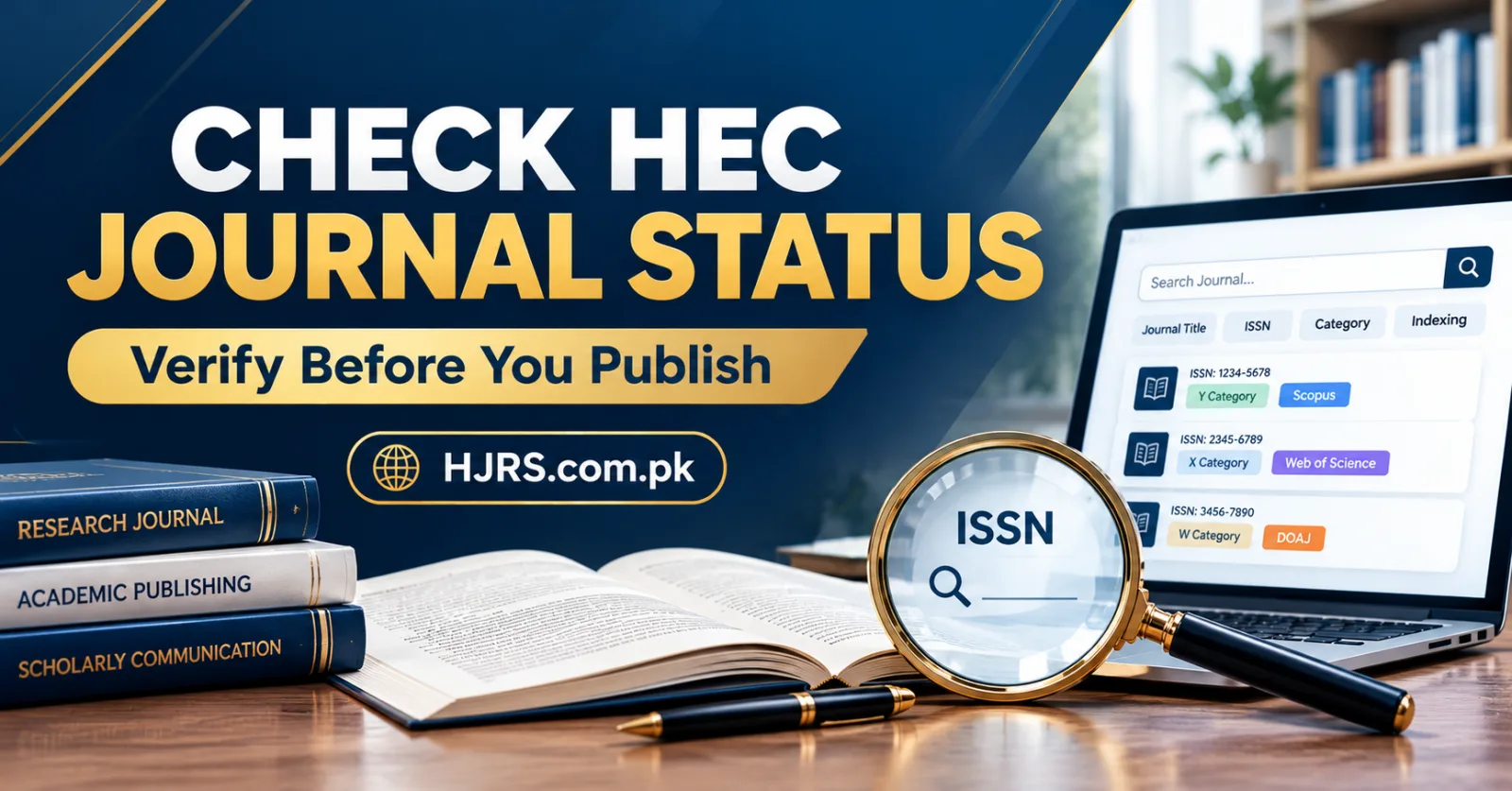
How to Check HEC Journal Recognition Status Before Publishing a Research Paper
Before submitting a research paper to an academic journal, one of the most important steps is to verify the journal's recognition status. Researchers in Pakistan often need to confirm whether a journal appears in the relevant Higher Education Commission (HEC) records, which category applies, and whether its recognition was valid during the period relevant to their publication.
Choosing a journal based only on its title, website, indexing claim, or a screenshot can lead to confusion. Journal recognition, international indexing, and acceptance by a university are related but distinct matters.
This guide explains how to check HEC journal recognition status, understand W, X and Y categories, verify a journal using its ISSN, review historical recognition records, and investigate indexing claims before submitting your manuscript.
Start your search: Visit HJRS.com.pk to explore journal records and available recognition and article-status verification tools.
Why Should You Check HEC Journal Recognition Before Publishing?
Researchers publish articles for many reasons, including postgraduate research, faculty career progression, institutional research requirements, and academic collaboration.
Depending on the applicable policy, a journal's recognition status may affect whether a publication meets a particular academic requirement. However, not every university or academic purpose uses identical rules.
Before submitting a paper, researchers should establish:
- The exact identity of the journal.
- Its print ISSN (p-ISSN) and electronic ISSN (e-ISSN), where applicable.
- Its HEC recognition category for the relevant period.
- Whether an official record identifies it as recognized, suspended, derecognized, or otherwise classified.
- Whether its claimed international indexing can be independently verified.
- Whether the journal meets the requirements of the relevant university or research programme.
Checking these details before submission can reduce the risk of relying on outdated or misleading information.
What Is HEC Journal Recognition?
The Higher Education Commission of Pakistan maintains journal recognition policies and publishes relevant journal lists and records.
The term HEC Journal Recognition System, commonly abbreviated as HJRS, is used in connection with this recognition framework. Journal categories are determined according to the applicable policy and the relevant recognition period.
Researchers should distinguish between an official HEC record and information presented by a third-party journal directory.
HJRS.com.pk is an independent journal-information platform designed to help users explore journal details, historical recognition records, indexing information, and available verification resources. It is not the official website of HEC.
For authoritative policy information, consult the Higher Education Commission website.
How to Check HEC Journal Recognition Status Online
Follow these steps before submitting your manuscript.
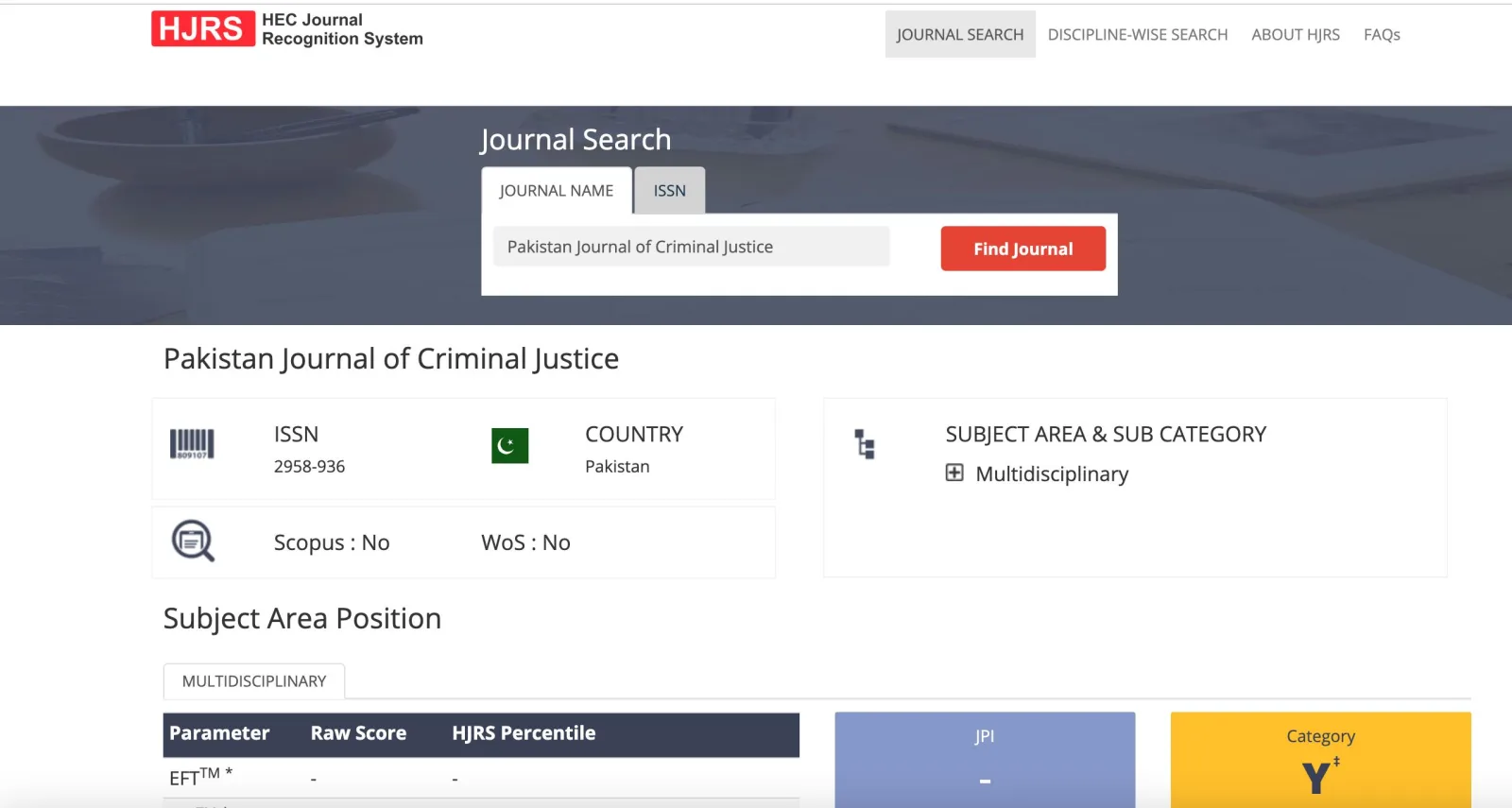
Step 1: Search for the Journal by Name
Open HJRS.com.pk and use the journal search feature.
Enter the journal's complete title or a distinctive part of its name. Where supported, alternative titles may also help you find the correct record.
Do not assume that two journals are identical simply because their names are similar. A journal may have a print edition, an electronic edition, a changed title, or a similarly named publication issued by another publisher.
Step 2: Verify the ISSN or E-ISSN
The International Standard Serial Number (ISSN) is an important identifier for a scholarly journal.
A print journal may have a p-ISSN, while its electronic version may have an e-ISSN. Some journals have both.
Compare the identifiers shown on the journal's website with those in the relevant database or recognition record.
This step is particularly important when different journals have similar titles or when a journal changes its name.
You can begin with the HJRS.com.pk journal search and inspect the matching journal profile.
Step 3: Check the Recognition Category
After identifying the correct journal, examine its recorded HEC category and the period to which that category applies.
The categories commonly discussed under the HEC recognition framework are W, X and Y. Their eligibility requirements depend on the applicable HEC policy.
A journal's category in an earlier list should not automatically be treated as its category in a later period.
If a record is marked as pending verification or the available source is incomplete, do not assume that the journal has been rejected or derecognized. Investigate the relevant official source before making a decision.
Step 4: Check the Historical Recognition Period
Historical status is important when an article was published in a previous year.
For example, a researcher may have published a paper in 2023 and need to determine which recognition list applied during the relevant period. Checking only the journal's current category may not answer that question.
A journal can appear differently across multiple recognition periods. The correct assessment depends on the applicable dates and the policy relevant to the researcher's purpose.
At HJRS.com.pk, explore the available journal history to see the recorded categories and their corresponding periods.
Always confirm which date matters for your case. An institution may apply a specific rule concerning submission, acceptance, or publication dates.
Step 5: Check the Journal's Indexing Status
Some journals claim to be indexed in Scopus, Web of Science, DOAJ, or other scholarly databases.
These services have different purposes and inclusion criteria. A claim of indexing should be checked against the relevant database rather than accepted solely on the basis of a publisher's website.
Useful resources include:
- Scopus for searching indexed scholarly literature and source information.
- Web of Science for searching its scholarly citation resources.
- DOAJ for discovering open-access journals included in its directory.
- OpenAlex for exploring scholarly works, authors, and research sources.
- Crossref for searching registered scholarly publication metadata and DOIs.
Remember that indexing and HEC recognition are not interchangeable. A journal's appearance in an international database does not automatically establish its current HEC category.
Step 6: Review the Evidence and Source
When checking a journal, look beyond a category label.
Review the source document, the recognition period, the journal identifiers, and the evidence supporting the result.
Where information is unavailable or conflicting, the result should be treated cautiously rather than presented as a definitive official decision.
HJRS.com.pk provides information about its verification approach and source limitations on its How We Verify page and its Data Sources page.
How to Check HEC Journal Status on the Date of Publication
One of the most important questions for a researcher is:
What was the journal's HEC recognition status when my article was published?
The answer may differ from the journal's status today.
To investigate this question, identify the journal using its ISSN or e-ISSN, establish the article's relevant date, and locate the recognition period covering that date.
Then examine the corresponding recognition record and source.
On HJRS.com.pk, the Check Article Status tool allows users to enter a journal identifier and date to investigate the applicable recognition period and category.
The result should be interpreted in light of the evidence shown and the requirements of the relevant institution.
For example, if a journal is listed in Category Y for one period and Category X for a later period, the later category should not automatically be applied to an earlier publication.
The date that matters for a degree or promotion requirement depends on the applicable HEC policy and the institution's rules. Researchers should confirm the relevant date before relying on the result.
What Do W, X and Y Journal Categories Mean?
W, X and Y are commonly used categories within the HEC journal recognition framework. Their criteria must be interpreted according to the relevant policy and effective period.
W Category
The W category has been associated with journals meeting the applicable HEC criteria, including specified Web of Science Core Collection indexes such as SCIE, SSCI and AHCI.
Researchers should confirm the journal's exact indexing record and the recognition period rather than relying only on a publisher's statement.
X Category
The X category has been associated with journals satisfying the relevant HEC criteria for this category. Depending on the policy, indexing conditions and additional requirements may apply.
Scopus indexing alone should not be treated as automatic proof of X-category recognition.
Y Category
The Y category covers journals meeting the applicable HEC criteria for this category.
Its eligibility requirements may depend on the policy version, indexing arrangements, and other conditions. A journal should not be assigned an official HEC category solely because a third-party source describes it as peer-reviewed or indexed.
For policy-specific definitions, consult the HEC journal category guide on HJRS.com.pk alongside the original HEC policy.
What Is the Difference Between Current and Historical Journal Status?
Current status refers to the journal's classification for a relevant present-day recognition period.
Historical status refers to the classification recorded for an earlier period.
These two views answer different questions.
A researcher preparing to submit a new paper may need to examine the currently applicable recognition list. A researcher reviewing an article published several years ago may need to identify the historical list covering the publication date.
A later recognition list does not, by itself, establish the journal's status in every previous year.
This is why researchers should examine both the recognition period and the underlying source rather than relying on a single category label.
Can You Verify a Research Article, Not Just a Journal?
Yes, journal-level and article-level searches serve different purposes.
A journal profile can help establish a publication's identity, ISSN, publisher, and available recognition history.
An article search can help locate an individual paper and examine its recorded bibliographic details.
The HJRS.com.pk Articles page provides search facilities for available article records using fields such as title, DOI, author, journal, and ISSN.
However, an article not appearing in a particular database does not automatically mean that it is invalid or unpublished. The available database may not contain every article.
Where a paper is not found, researchers should consult the journal's official issue page, DOI record where available, and the relevant recognition records.
Similarly, bibliographic metadata alone does not prove that an article's HEC recognition status has been officially accepted for every academic purpose.
How to Identify Potentially Misleading Journal Claims
Before submitting a paper, be cautious if a journal:
- Claims HEC recognition without providing a verifiable source.
- Advertises a category without specifying the applicable period.
- Uses a title similar to a reputable journal but displays a different ISSN or website.
- Claims indexing that cannot be confirmed in the relevant database.
- Guarantees acceptance or publication without a credible review process.
- Provides unclear publication fees or editorial information.
- Displays old recognition documents as if they establish its present status.
These warning signs do not automatically prove misconduct, but they justify further investigation.
Always verify the journal's identity, editorial policies, and recognition evidence before paying publication fees or submitting your manuscript.
Why Use HJRS.com.pk for Journal Research?
HJRS.com.pk is designed to make journal information and recognition checks easier to explore.
Its available features include:
Journal search: Search for journal information using titles and supported journal identifiers.
Journal profiles: Explore available information about journal identity, publisher, subject area, and recognition history.
Historical recognition: Review records from different recognition periods instead of assuming that the latest category applies to every previous year.
Article-status checking: Investigate the recognition period and category relevant to a specified journal identifier and date.
Article search: Find available research article records using bibliographic search fields.
Indexing information: Explore available indexing information and consult the relevant source databases for independent verification.
Verification transparency: Review how source records are matched, what evidence is retained, and what limitations apply.
Start with the HJRS.com.pk homepage, read the verification methodology, and consult the data sources page for further details.
HJRS.com.pk is an independent informational resource. Official HEC records and policies take precedence where an authoritative determination is required.
Frequently Asked Questions
How do I check whether a journal is HEC recognized?
Search for the journal by title or supported identifier, review its recorded category and recognition period, and verify the result against the relevant official HEC source.
How can I check HEC journal status by ISSN?
Use the journal's p-ISSN or e-ISSN to identify the correct record. Compare the identifier with the journal's official website and relevant recognition records.
Can a journal's HEC category change?
A journal's recorded status can differ across recognition periods. Always check the applicable policy and period instead of assuming that an earlier category remains valid indefinitely.
Is a Scopus-indexed journal automatically HEC recognized?
No. Scopus indexing and HEC recognition are separate matters. Check the applicable HEC criteria and relevant recognition record.
How can I check the status of a journal when my paper was published?
Identify the journal, determine the relevant article date, and examine the recognition list covering that period. Confirm whether the relevant institution uses the publication date or another date for its assessment.
What does Pending Verification mean?
It indicates that the available information has not been conclusively verified for the relevant record. It should not automatically be interpreted as rejection, suspension, or derecognition.
Is HJRS.com.pk an official HEC website?
No. HJRS.com.pk is an independent journal-information platform. Consult the official HEC website for authoritative policies and recognition decisions.
Conclusion: Verify Before You Publish
Choosing the right journal is an important part of responsible academic publishing. Before submitting a research paper, verify the journal's identity, examine its recognition category and period, check its indexing claims, and confirm that it meets the requirements relevant to your academic purpose. https://hjrs.com.pk/journals
Do not rely exclusively on an old screenshot, a publisher's promotional claim, or a category displayed without supporting evidence.
Use HJRS.com.pk to explore journal records, investigate historical recognition, and access available journal and article search tools. When an official decision is required, consult the relevant HEC records and your institution. https://hjrs.com.pk/journal-directory
Check carefully. Verify the source. Publish with confidence.
Disclaimer: HJRS.com.pk is an independent educational and informational platform and is not the official website of the Higher Education Commission of Pakistan. Information on the platform may have limitations or require further verification. Official HEC records and applicable institutional policies take precedence.
This article is general guidance based on the information available on its publication date; HEC policies and lists are the authority. Terms & conditions apply.
Keep reading
How to Check HEC Recognized Journals in Pakistan (2026-27 Guide)
Learn how to check HEC recognized journals in Pakistan, verify W/X/Y categories, confirm ISSN details, review recognition periods, and use official HE…
HJRS: HEC Journal Recognition System – Recognized Journals Guide
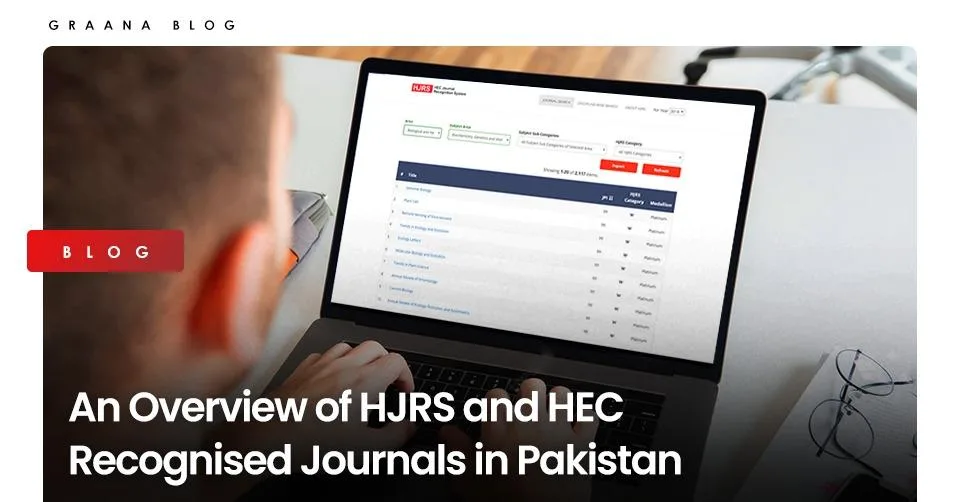
Learn what the HEC Journal Recognition System (HJRS) is, how W, X and Y journal categories work, how to verify a journal by title or ISSN, and how to…

HEC Journal Recognition System (HJRS): Complete Guide
The HEC Journal Recognition System (HJRS) helps researchers understand journal recognition and categories in Pakistan. Learn about W, X and Y categori…